


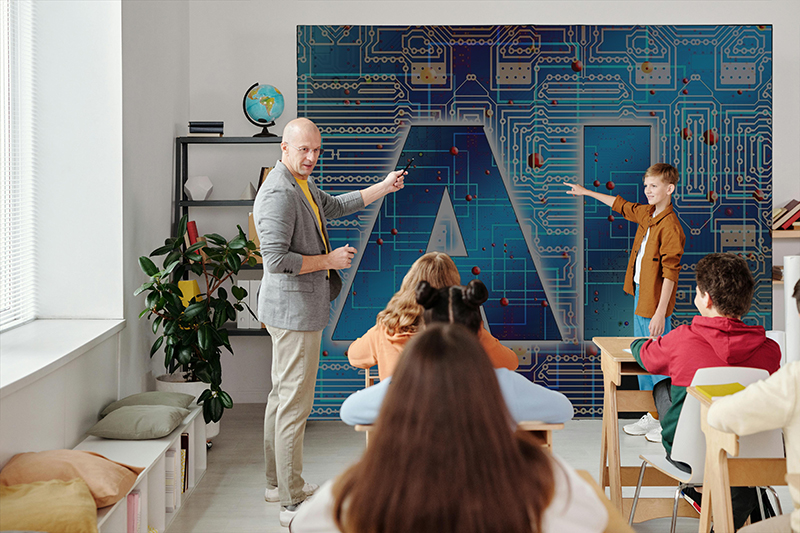
Do you know who is teaching your child? It’s a fair question to ask and keep asking as, yes, AI in one form or another, is probably already in your child’s classroom. According to Statista, globally 86% of students said they were using AI tools in their schoolwork. Almost a fourth of them use it on a daily basis.
AI in education looks like adaptive learning platforms that customize content for individual students; automated grading and scheduling to free up teachers’ time; and interactive tools to make learning more engaging. Your kids are likely seeing examples of generative AI, realistic content, such as text, images, videos, audio and other media, that enhances learning and teaching.
As AI continues to be integrated into education, largely untested and unchecked, a trending point of view is that AI will bring unprecedented opportunities for personalized learning, administrative efficiency and improved educational outcomes and will break down education barriers thanks to tools that support students with diverse needs and learning styles. No doubt, this vision, if true, would have far-reaching and profoundly positive impacts.
Here’s the thing, we don’t yet know if this is true and it feels very risky to have our kids be the experiment. After all, a new study from Microsoft and Carnegie Mellon University found over-reliance on generative AI to erode critical thinking skills. Please note, this study was on adults and there is not adequate data on kids. We don’t know if AI in the classroom is a prescription for making kids smarter or dumber! But if the risk for adults is, ‘if you don’t use it, you lose it’, the implications are ominous for early learners, who may miss the developmental opportunity to develop critical thinking skills because of a too-early engagement with AI.
Educators and students need the necessary skills and support to use AI successfully. Some concerns include:
- Copyright infringement risks leading to accidental plagiarism
- Perpetuation of ‘digital divides’
- Young people having fewer interactions with educators and classmates
- AI exposing young people to inappropriate, harmful content, politically and culturally biased or factually incorrect information
- Loss of critical thinking skills
Parents and educators, this is NOT a Mel Robbins ‘Let Them,’ moment. Pay attention and advocate for our youngest children, our early learners, to slow the introduction of AI in the classroom. AI should be used in appropriate situations to help the development of learners in very specific situations, but not be used as a substitute for hands-on learning, experiential learning, and human educators, playing an active role in the learning process for children of all ages. reducing learners’ ability to problem-solve by themselves.
There is a growing importance for education about AI for those in education, and for the general population, to safeguard against ethical harms. So, parents and educators, teach your kids about AI literacy and preserve tech-free experiences for our youngest learners. Let them learn as much as possible without AI until the promise and potential of AI can be tested and verified. And no, your children will not be left behind in their skills compared to other kids by focusing on true early human childhood education needs. Get them hands-on exploring with their five senses so they learn to live (and thrive!) in our physical world with other humans.
Conversation Starters for Kids
- Have you used Chat GPT yet? What was your impression?
- What other AI tools have you used?
- Do you think that AI will change or replace certain industries?
- Would you be comfortable seeing an “AI Doctor” or an “AI Nurse”?
- Do you think that AI will change education? If so, how?
- Would you send your child to a school where the teachers were all humanlike robots powered by AI?
Learn More
- Artificial intelligence: education and impacts on children and young people
- The Impact of Generative AI on Critical Thinking: Self-Reported Reductions in Cognitive Effort and Confidence Effects From a Survey of Knowledge Workers
- Man Accused Of Using AI To Impersonate Maryland Principal Arrested On Child Pornography Charges
- S. Opinion On The Impact Of AI On Student Learning After High School 2024
- These Schools Are Banding Together to Make Better Use of AI in Education
- Stanford Research Hub to Focus on AI for K-12 Education
- Digital Parenting by the Ages
- Savvy Cyber Kids Featured Conversation Starters
Savvy Cyber Kids educates and empowers digital citizens, from parents and grandparents, to teachers and students. Sign up for our free resources to help you navigate today’s digital world with cyber ethics. See more cyber safety and cyber ethics blogs produced exclusively for EarthLink. Looking for a social media parental control? Try a 30-day free trial of Bark. If you sign up after your trial, Bark donates 25% of your monthly fee to Savvy Cyber Kids.
Thank you to the Savvy Cyber Kid’s sponsors!
Interested in becoming a Savvy Cyber Kids sponsor? Email Ben Halpert.